



by William Quesada, on Jan 5, 2026, 2:54:10 PM
Code modernization is about more than looking modern; enterprises require high end functionality with modern standards.
We ran a side-by-side analysis where we pitted GAP’s Deterministic (think precision) AI migration engine against the industry’s hottest Generative AI models (GitHub Copilot Agent mode and Claude Sonnet 4) and the results were a reality check for anyone hoping for a migration “magic button”. Generative AI is brilliant (how else would I generate all those meeting notes??) but it lacks the structural backbone required for enterprise-scale modernization.
Tool Panic!
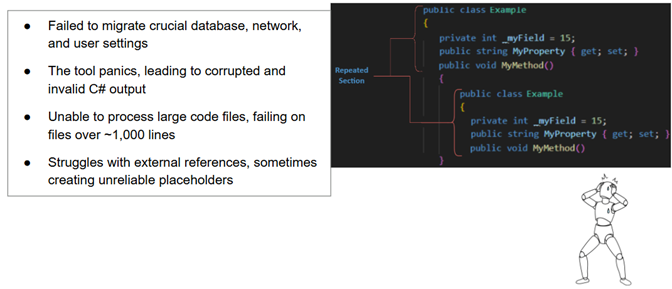
We’ve seen what happens when you ask a probabilistic model to do a compiler’s job. In our head-to-head testing, Generative AI exhibited “tool panic” on files exceeding 1,000 lines, leading to output corruption and incomplete migrations. The LLMs routinely missed critical structural elements like database connections, network settings and user configurations. These are external to the raw code file but vital to the application.
Our precision-focused Deterministic AI engine, however, maintained total integrity regardless of file size, providing a predictable 1:1 rule mapping that’s auditable for regulatory compliance. In other words, you get consistent, traceable results at any scale.
The GAPVelocity AI Strategy: Dual Engine Innovation
Leading in AI means knowing exactly where the models break. We don’t choose between stability and style; we use a hybrid, foundation-first strategy that treats GenAI as a powerful accelerator to complement our proprietary rules-based AI engine:
- Step 1: Precision Baseline. We use our rules-based, deterministic AI engine to execute the high-volume, stable conversion. This ensures structural integrity and the reliable migration of all critical app settings.
- Step 2: Generative Polish. We augment and optimize with GenAI to modernize patterns, suggest current language idioms and clean up verbose code blocks.
- Step 3: Expert Oversight. Every single line, deterministic or generative, is validated by a skilled engineer to ensure the modernization never compromises system stability.
This is the high level view of our research. Check out the details below to understand exactly what we did and what we learned.
The Indispensable Strength of Deterministic AI
The Deterministic approach is the backbone of a secure and compliant migration. Its inherent fixed logic solves the primary risks associated with large-scale code conversion, as highlighted in our discoveries:
- Unrivaled Stability and Predictability: Deterministic AI is the most robust way to generate high-quality and stable migrated code. An input always yields the same C# output. This guaranteed consistency drastically reduces the testing overhead required, as you are qualifying a rule set, not a probabilistic model.
- Structural Integrity and Context Preservation: Deterministic tools are specifically engineered to handle application structures. They reliably migrate crucial elements external to the raw code file (think networks, user settings) that often fail to be recognized or included.
- Scalability and Resilience: In our experiment, the generative AI tool exhibited a critical failure in scalability, resulting in "tool panic," output corruption, and incomplete migrations for files exceeding 1,000 lines. The deterministic system, built on formal parsing logic, demonstrated superior resilience by maintaining output integrity and consistent performance across all file sizes, confirming its reliability for large-scale code migration tasks.
- Scalability Failure on Large Inputs: The Generative AI tool demonstrated a critical lack of robustness, confirming that the current generative approach is unsuitable for reliable, high-volume code migration projects where the deterministic system maintains consistent integrity.
- Auditability and Governance: Every line of code translated by a Deterministic tool can be traced back to its specific rule. This provides a clear, auditable migration path, which is vital for regulatory compliance and long-term maintenance control.
The Complementary Role of Generative AI
While Deterministic AI secures the foundational reliability, it brings unique value in the final refinement stages:
- Modernity and Style: The code produced by GenAI is often more modern compared to the Deterministic output, suggesting current C# idioms and patterns that a rule-based system may miss.
- Speed for Small Samples: is quick and produces good quality code for small, isolated samples, making it a useful tool for iterative assistance. This is perfect for modernizing specific functions or cleaning up localized verbose code blocks.
The Critical Limitations of Generative AI
Despite its benefits, the inherent unpredictability of GenAI poses risks that disqualify it from being the primary migration engine today.
Our analysis revealed significant "issues" that need careful consideration:
- Instability and Gaps: Although VB.NET and C# are modern programming languages, they still introduce unknown gaps and instability in the migration path, meaning we can't fully rely on them yet.
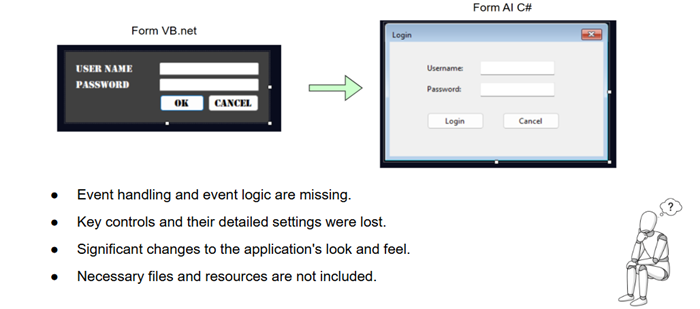
- Loss of Functionality (UI Migration): struggles significantly with complex, functional elements. In UI migrations, it was observed that event handling and event logic were missing, and key controls and their detailed settings were lost. This often resulted in significant changes to the application's look and feel.
- Scalability Failure on Large Inputs: The Generative AI tool demonstrated a critical lack of robustness, confirming that the current generative approach is unsuitable for reliable, high-volume code migration projects where the deterministic system maintains consistent integrity.
|
Feature |
Deterministic AI (Rule-Based) |
Generative AI (LLM-Based) |
|
Stability / Robustness |
Highest (Robust) |
Lower (Introduces unknown instability) |
|
Speed / Velocity |
Standard (Consistent, governed by rules) |
High (Quick for small, iterative samples) |
|
Code Size Handling |
Excellent (Handles files >1,000 lines) |
Poor (Fails on files >1,000 lines) |
|
Critical Context Migration |
Excellent (Migrates settings, network, DB info) |
Poor (Fails to migrate crucial settings) |
|
Code Modernity |
Functional but Dated |
High (Produces more modern code) |
|
Auditability |
Full (Traceable 1:1 rule mapping) |
Limited (Probabilistic output) |
Table 1: summary of features and capabilities.
Conclusion: The Hybrid, Foundation-First Strategy
The most effective, risk-mitigated strategy for to C# migration, as indicated by our analysis, is a hybrid approach that places Deterministic AI first:
- Baseline with Deterministic AI: Use the Deterministic tool to execute the initial, high-volume, and stable conversion. This ensures structural integrity and the reliable migration of all critical application settings.
- Refine with GenAI: Apply as an optimizer to modernize and clean up the Deterministic output. This is where it acts as an accelerator, not the driver.
- Human Oversight is Key: Using a Refinement Prompt is critical for achieving the highest quality in the GenAI-assisted stage. Crucially, all output, Deterministic and Generative, must be validated by a skilled developer to integrate the modernizations without compromising stability.
The future of code modernization is layered: it relies on the stability of Deterministic rules to provide the foundation, and the intelligence of Generative AI to apply modern polish.
Want to discuss your modernization project? Reach out!

William Quesada is GAPVelocity AI Director of Engineering

