



by DeeDee Walsh, on Jun 15, 2026, 12:15:00 AM
Twenty-eight years ago Microsoft unleashed Visual Basic 6.0 on a world that was blissfully unaware of the concept of "technical debt." We dug up the original press release and added the footnotes that history (and several thousand sleepless nights) wrote for us.
On June 15, 1998, Microsoft claimed VB6 would change the world. In 2026, reading this feels less like a press release and more like a warning label found on an unexploded ordnance. Some of it is hilarious. Some of it is haunting. And if you’re currently maintaining a VB6 app, some of it is probably why you have that eye twitch.
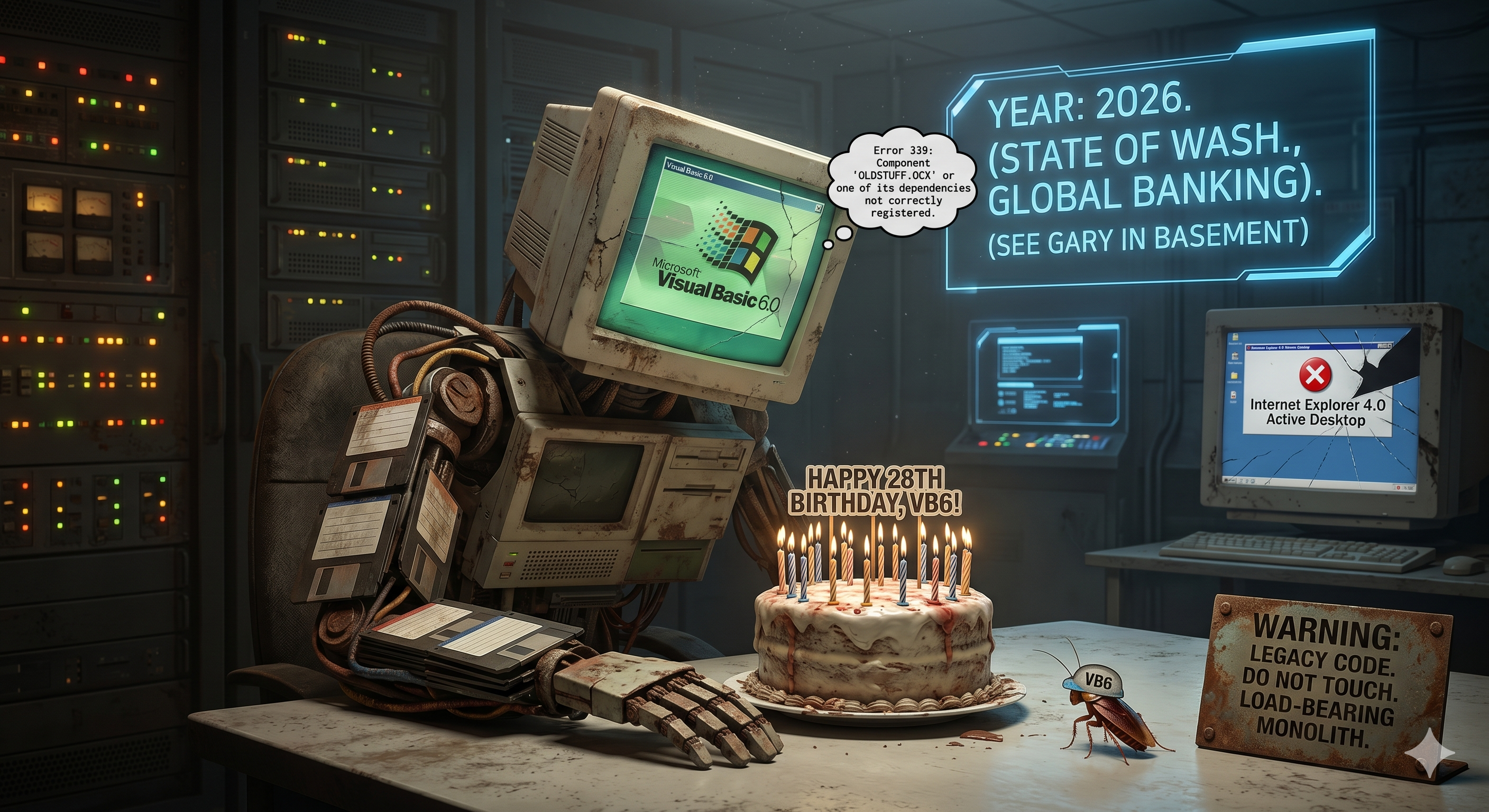 My record for creating terrible AI art remains unblemished
We’re not here to dunk on 1998 Microsoft (I was a VB6 PM so I can say with a straight face, VB6 was legit!) VB6 was a masterpiece of democratization; it let people ship software without having to understand C++ pointers or the dark art of memory management. It worked so well that it became immortal. Here are the predictions and prognostications from 28 years ago that still live to fight the good fight.
"version 6.0 of the Microsoft Visual Basic development system, the world's most popular rapid application development (RAD) tool"
- 1998: A bold, swaggering claim.
- 2026: Still arguably true, but in the same way that "The Flu" is a popular virus. Nobody is choosing to start a VB6 project in 2026 unless they’re being held for ransom, yet the sheer volume of code still running the global economy means the title hasn't been surrendered. It’s the cockroach of IDEs: it will survive the heat death of the universe and still be asking for a missing
.ocxfile.
"the new data access and Web development features... extend its awesome productivity to a new breed of distributed applications."
- 1998: "Awesome productivity." "New breed."
- 2026: That "new breed" is now a 28-year-old "ancient breed" of load-bearing monoliths. The "distributed" part usually means there’s one guy named Gary in the basement who is the only person who knows how the COM+ components talk to each other across a server that literally glows red.
"Today, 95 percent of developers using Visual Basic build solutions that access data."
- 1998: A statistic to sell the new ADO (ActiveX Data Objects) tooling.
- 2026: This is the Original Sin of the release. It means 95% of VB6 apps are hard-coded to databases that are older than the interns. This is why you can’t just rewrite it. The business logic isn’t in a spec; it’s buried in the way a
Recordsetwas handled in aTry-Catchblock that doesn't actually exist.
"The new WebClass Designer simplifies the creation of Web applications..."
- 1998: RAD comes to the web!
- 2026: Pour one out for the WebClass Designer. It was the tech equivalent of New Coke. It arrived with a bang and died so fast that most developers today think it’s a class you take at a gym. If you are still running a WebClass app in 2026, you don't need an upgrade; you need an exorcist.
How I think about the WebClass Designer in 2026
"The Dynamic HTML Page Designer enables the creation of Microsoft Internet Explorer 4.0-based applications…"
- 1998: Cutting edge!
- 2026: This line aged like a tuna sandwich left in a hot car. Tying your software’s soul to IE4 was a deal with the devil we didn't realize we were signing. It’s a reminder that while the web parts of 90s tech died in a fire, the desktop forms became eternal. The
.frmfiles outlived the browser wars, the mobile revolution, and several empires.
"Major enterprises, including the state of Washington, GMAC Commercial Mortgage Corp., and Banker's Trust... have built enterprise-level applications with Visual Basic."
- 1998: Logos for credibility.
- 2026: Translated: "These organizations will still be running this exact same code in 2026." When your marquee customers are state governments and mortgage companies, you aren't describing a "tool"; you’re describing the foundation of a civilization. This code doesn't get retired; it gets inherited like a boomer's Hummel collection.
"Language enhancements for high-performance string manipulation"
- 1998: A nice performance bullet.
- 2026: Every VB6 maintainer just felt a cold wind blow through the room. "High-performance string manipulation" in VB6 is why your 2 p.m. meeting is always about why the parser just broke because someone put a semicolon in a text field.
The Pricing of Immortality
"Pricing and upgrade policies will be announced at that time."
- 1998: Standard corporate fluff.
- 2026: The word "upgrade" is doing enough heavy lifting here to win a gold medal in powerlifting. Microsoft eventually gave us the VB Upgrade Wizard, which we (the folks at GAP) actually helped build. The truth? It was a bridge that got you 60% of the way across a 100% wide canyon. The remaining 40% is why we still have jobs 28 years later. Nobody lied; they just didn't realize that "good enough to ship" would become "too important to ever touch again."
The Line That Wasn't There
Here is what the 1998 PR team couldn't say: This tool would be so ridiculously good at its job that the resulting software would outlive the IDE, the OS it was built for, and the careers of the people who wrote it.
That’s not a failure. It’s the ultimate flex. You don't keep a 28-year-old app running because you're lazy; you keep it running because it’s the only thing in the building that still works.
Happy 28th, VB6. You’ve been a nightmare, a legend, and a paycheck for three generations of developers. You earned the grey hair you gave us.
P.S. If you want to see exactly how much "1998" is still lurking in your codebase including how many
Globalvariables are plotting your downfall and how deep the DLL Hell actually goes, ByteInsight is free. It runs locally, doesn't ship your code to the cloud, and tells you the truth, however ugly it is. Point it at your.vbpand see what you inherited.


