



by Cheyenne Sokkappa, on May 17, 2026, 12:00:00 AM
Microsoft SQL Server 2016 reaches end of extended support on July 14, 2026. After that date, security patches, bug fixes, and Microsoft support will stop.
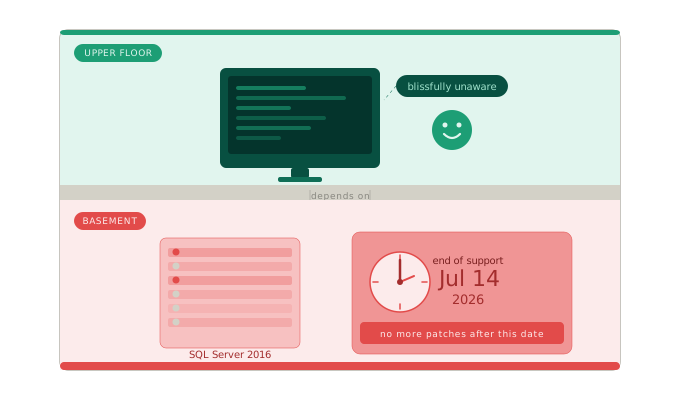
This puts your database at risk. IT teams and mid-market press have been on this story for months, and they're right to be. If you're running SQL Server 2016 in production, you have nine weeks to act.
But there's a budget line missing from almost every EOS planning conversation — and it's the one that will determine whether your remediation actually holds.
The database isn't the problem. The application on top of it is.
One of the most common challenges in SQL Server upgrade assessments is that businesses become stuck on a specific version because of an application that doesn't support a more current version.
How can you upgrade your SQL server when it's tied to a legacy app like VB6, Access, or a legacy .NET application that's been running on top of it for 20 years.
You can migrate your database to Azure SQL Managed Instance or upgrade to SQL Server 2022. Both are achievable. But if the application layer above it was built in 2003, hasn't been touched since, and no one on your current team fully understands it, the database migration is the easy part.
The friction around SQL Server 2016 EOL isn't really about choosing a migration path. It's about not knowing what you're actually dealing with.
That's doubly true for the application tier. Teams can inventory their SQL instances. They often can't inventory what depends on them, what breaks if the schema changes, and what business logic lives only in the application forms.
Where do ESUs Help You
Microsoft's Extended Security Updates provide critical security patches only: no new features, no performance fixes, no bug fixes. ESU pricing roughly doubles annually. By year three, you're paying 300–400% of the original license cost.
ESUs are a bridge, not a destination. And they don't buy you time on the application problem. They buy you time on the database problem, while the application problem compounds.
The teams that come out of this well are the ones who treat the SQL EOS deadline as the trigger for a broader conversation.
That's where VELO comes in.
GAPVelocity AI has spent 35 years modernizing exactly the kind of legacy applications that sit on top of databases like SQL Server 2016. VB6 forms, Access applications, Classic ASP, PowerBuilder, Clarion. These legacy applications run core business operations, and modernizing them is sure to be painful.
VELO converts those applications to production-ready C#/.NET with 90–95% automation and 100% business logic preserved using Agentic AI. VELO conversions preserve the business logic while bringing the application stack into the modern era.
The SQL EOS deadline is real. Don't spend your remediation budget buying three more years of borrowed time on the database while the application problem waits.
→ Start with a VELO Assessment. Know your automation coverage before you commit.


